AI Visibility Audit Methodology
Sanchari Sarkar, AI Visibility Strategist
Version 4.2
Published: 3 August 2026 · Last updated: 3 August 2026
Estimated reading time: 8–10 minutes
This page explains the principles, dimensions, and evidence types used by the Digital Platform 271 AI Visibility Audit. Proprietary scoring weights, internal thresholds, and anti-manipulation logic are intentionally not disclosed in order to preserve the integrity of the assessment.
Table of Contents
- Executive Summary
- Why We Developed This Methodology
- What the Audit Measures
- The 53-Signal Framework
- Evidence Collection
- Scoring Model
- Technical AI Visibility vs AI Recommendation
- Recommendation Testing
- What the Methodology Does Not Claim
- Version History
- Suggested Citation
- Related Research and Tools
Executive Summary
Traditional SEO metrics remain useful for understanding crawlability, indexation, rankings, and search demand. They do not, by themselves, explain whether an AI system can identify a business, connect its entities, verify its claims, or confidently recommend it in response to a category question.
Technical readiness and recommendation readiness are related but different. A technically accessible website gives search and AI systems material they can retrieve. Recommendation readiness depends on additional semantic clarity, corroborating evidence, citation authority, audience fit, and confidence.
The Digital Platform 271 AI Visibility Audit is intended to measure the observable conditions that support AI discoverability, understanding, trust, content coverage, and recommendation readiness. It provides a structured baseline for identifying gaps and prioritising improvements.
The methodology is not intended to predict rankings, guarantee citations, or promise recommendations from any AI platform. It evaluates evidence and readiness at a point in time, not a guaranteed future outcome.
Why We Developed This Methodology
Traditional SEO does not fully explain AI recommendation behaviour. Search rankings can indicate visibility in a results page, but generative systems also synthesise information, compare entities, evaluate evidence, and decide whether they have enough confidence to mention or recommend a business.
A technically strong website may still lack semantic authority or citation authority. Its pages may be crawlable and well structured while its category, audience, use cases, differentiators, supporting proof, or external corroboration remain unclear.
This methodology was developed to evaluate the broader conditions that influence AI discoverability and recommendation readiness. It combines technical, semantic, entity, citation, trust, content, and recommendation-oriented evidence in one assessment framework.
What the Audit Measures
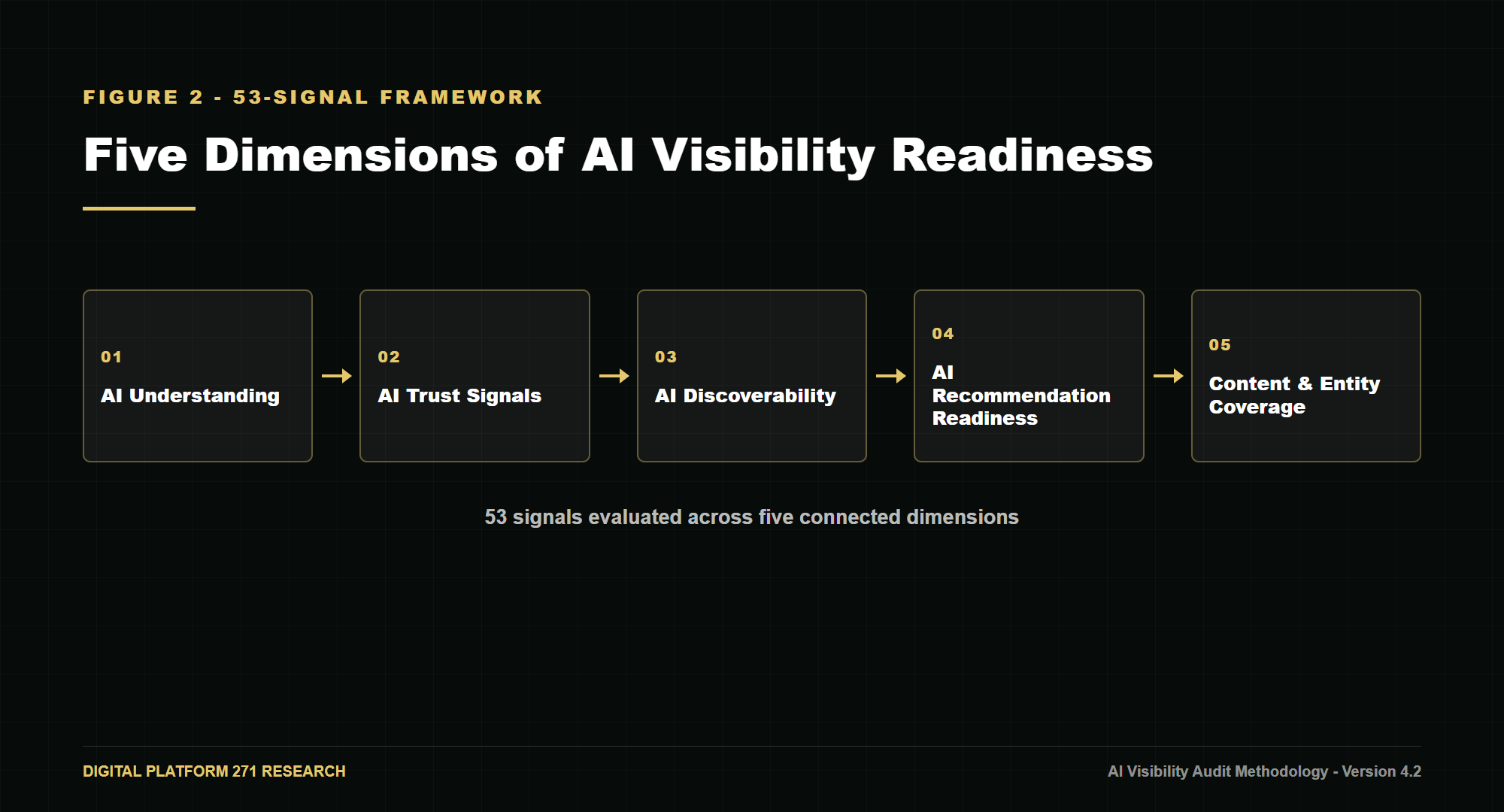
The audit uses five official benchmark dimensions. Each dimension has a distinct objective and reviews different, sometimes overlapping, evidence.
AI Understanding
Objective: Assess whether a machine can clearly identify the business, its category, its offerings, and the relationships between important entities.
Evidence reviewed: Business and founder identity, organization information, product and service definitions, authorship, structured relationships, and consistent naming.
Representative signals: Organization identity, founder identity, entity relationships, category clarity, product or service definitions, and authorship.
Why it matters: AI systems need a stable understanding of who the business is and what it does before they can accurately describe or compare it.
AI Trust Signals
Objective: Assess whether important claims are supported by credible, verifiable evidence.
Evidence reviewed: Reviews, credentials, case studies, editorial mentions, public references, contact information, and corroborating proof.
Representative signals: Review evidence, public contact methods, founder credentials, case-study proof, editorial references, and third-party validation.
Why it matters: Trust evidence helps AI systems distinguish supported claims from unverified promotional language.
AI Discoverability
Objective: Assess whether relevant content can be crawled, rendered, interpreted, and reached through a coherent website structure.
Evidence reviewed: Robots directives, canonicals, metadata, rendering accessibility, structured data, internal links, indexable pages, and technical page signals.
Representative signals: Crawlability, canonical consistency, page metadata, rendered content access, structured data, and internal linking.
Why it matters: Information cannot contribute to AI visibility if systems cannot reliably retrieve or interpret it.
AI Recommendation Readiness
Objective: Assess whether the website provides enough clarity and evidence for a system to consider the business in recommendation-oriented contexts.
Evidence reviewed: Audience and use cases, comparison readiness, answer-first sections, proof, next steps, FAQs, and recommendation-supporting content.
Representative signals: Clear use cases, answer-ready blocks, comparison content, practical next steps, FAQs, differentiation, and corroboration.
Why it matters: Being discoverable is not the same as being recommended. Recommendation requires stronger evidence, fit, and confidence.
Content & Entity Coverage
Objective: Assess whether the website covers the people, offerings, topics, and relationships needed for a complete machine-readable picture of the business.
Evidence reviewed: Organization and founder information, products, services, authorship, topic depth, supporting pages, and content consistency.
Representative signals: Entity coverage, service coverage, product clarity, author information, topical consistency, and supporting content.
Why it matters: Incomplete coverage leaves important questions unanswered and weakens the context available to search and AI systems.
The 53-Signal Framework
The audit evaluates 53 signals across the five dimensions. These signals are grouped into broad evidence families so that the assessment considers more than one type of website evidence.
Technical evidence
- Crawlability
- Robots directives
- Canonical tags
- Structured data
- Metadata
- Rendering accessibility
Semantic evidence
- Answer-ready content
- Topic coverage
- Entity clarity
- Relationships between pages
- Audience and use-case clarity
Citation and trust evidence
- Reviews
- Editorial mentions
- Credible external references
- Brand mentions
- Supporting research
Recommendation-readiness evidence
- Use cases
- Comparison readiness
- FAQ and answer blocks
- Clear next steps
- Proof and corroboration
Content and entity evidence
- Organization identity
- Founder identity
- Products
- Services
- Authorship
- Topical consistency
The full proprietary scoring formula is not published. Individual weights, internal thresholds, and anti-gaming rules are intentionally excluded from this public methodology.
Evidence Collection
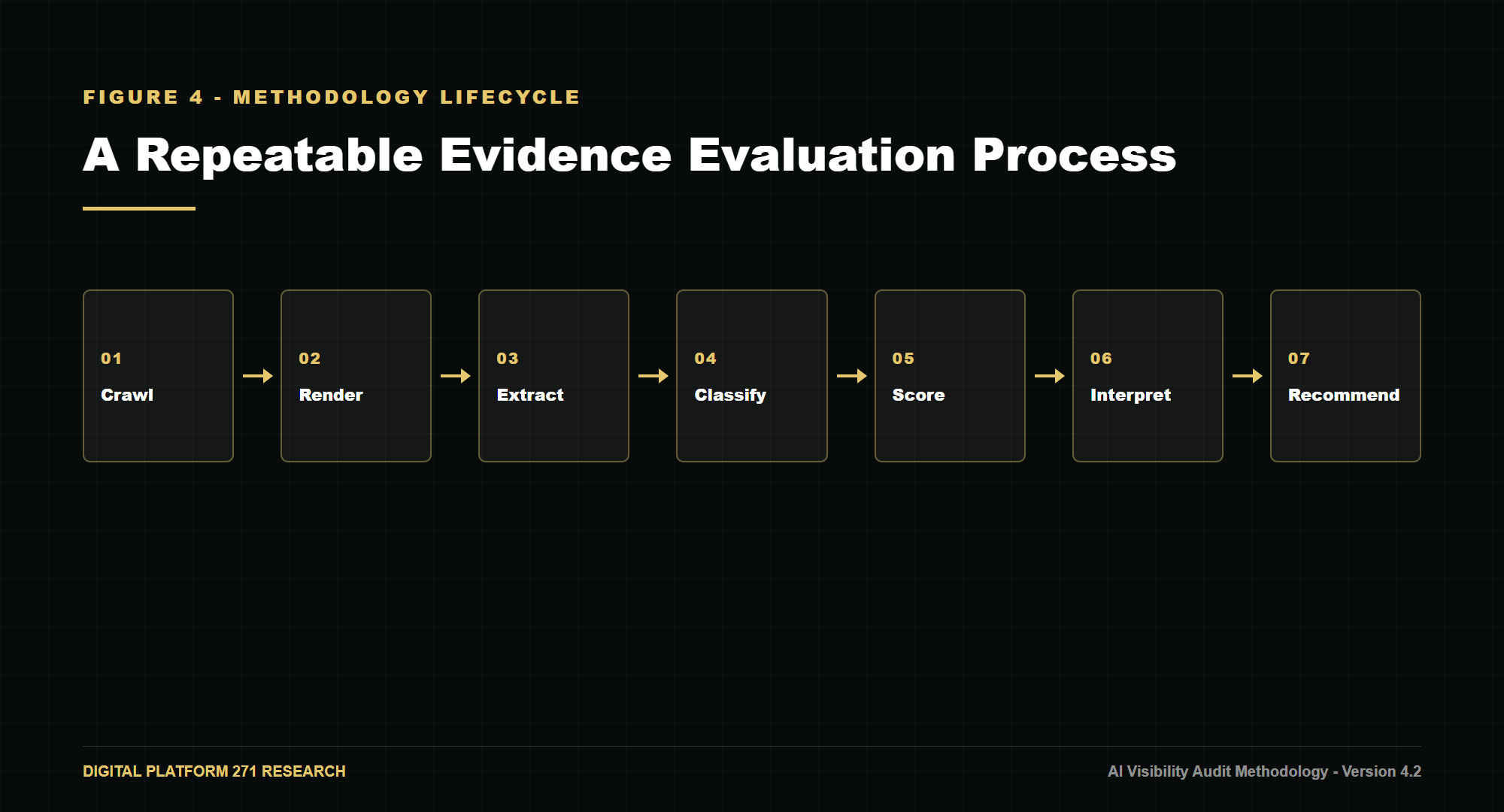
The audit collects and evaluates evidence from raw HTML, prerendered HTML, the rendered DOM, metadata, structured data, headings, lists, tables, cards and grids, FAQs, visible text, internal links, and public external sources where applicable.
Browser rendering is used where required for JavaScript and single-page application websites. This helps distinguish information that exists only after rendering from information available in the initial server response.
Evidence is classified according to its source and strength:
- Verified DOM evidence: Content or structure confirmed in the rendered page, including headings, sections, cards, lists, links, and visible relationships.
- Structured evidence: Machine-readable metadata or structured data that explicitly identifies entities, offerings, relationships, or page meaning.
- Public-source evidence: Relevant evidence available from credible public sources outside the audited website, where applicable.
- Keyword inference: A cautious inference based primarily on loose words or phrases without strong structural confirmation.
Weak keyword-only evidence is treated more cautiously than verified structural evidence. A phrase appearing once is not automatically equivalent to a clearly labelled, visible, and well-structured section.
Scoring Model
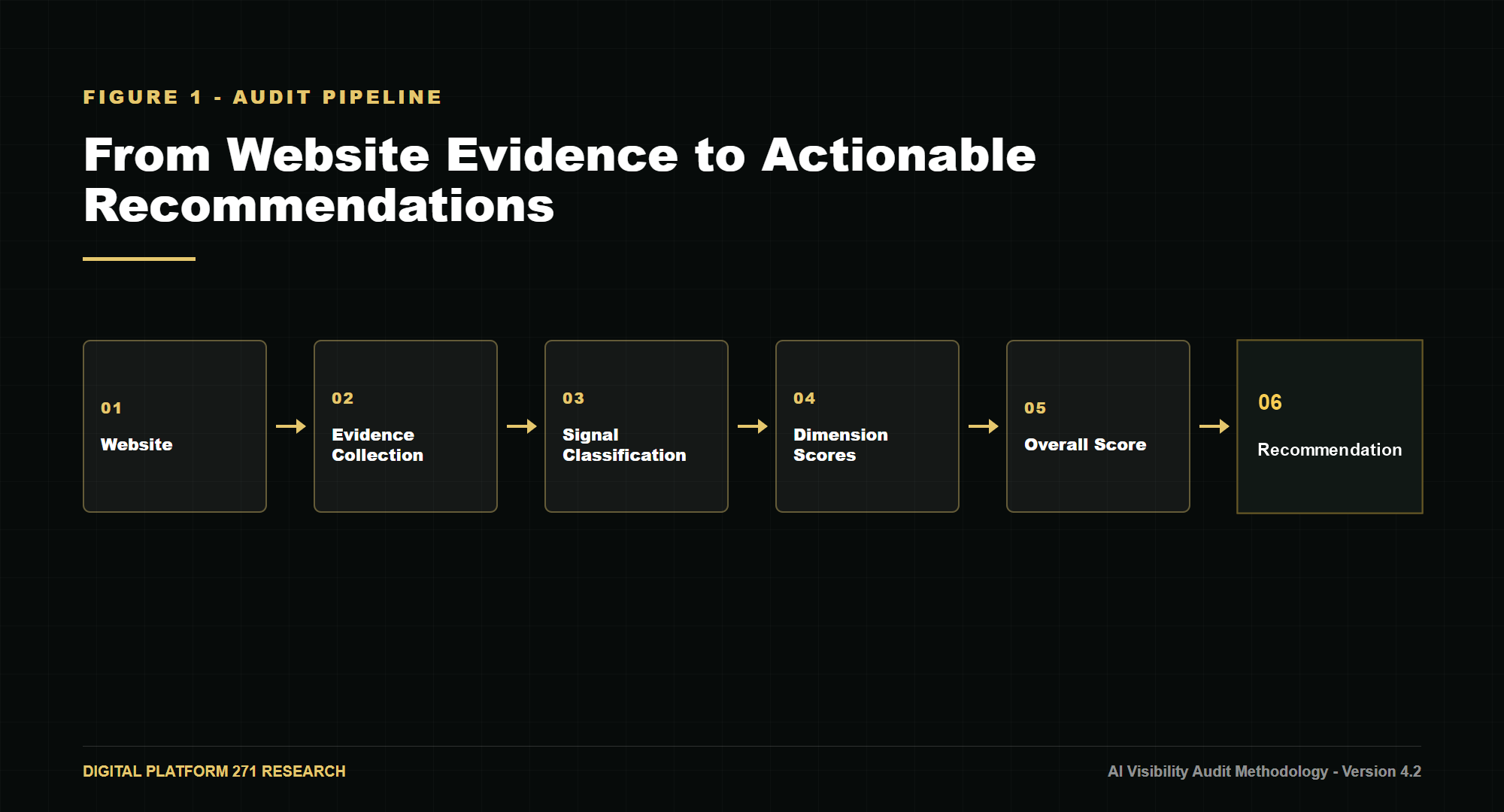
Each signal contributes to a dimension score, and the five dimension scores contribute to the overall score. The final score is presented out of 100 and is accompanied by a grade.
Not every signal has equal influence. Missing evidence, partial evidence, and verified evidence are treated differently according to the role and strength of the signal. The scoring model is designed to reward supported evidence rather than isolated terminology.
A strong technical score does not guarantee AI recommendation visibility. Technical readiness establishes access and machine readability; recommendation confidence depends on additional semantic, citation, trust, and audience evidence.
Technical AI Visibility vs AI Recommendation
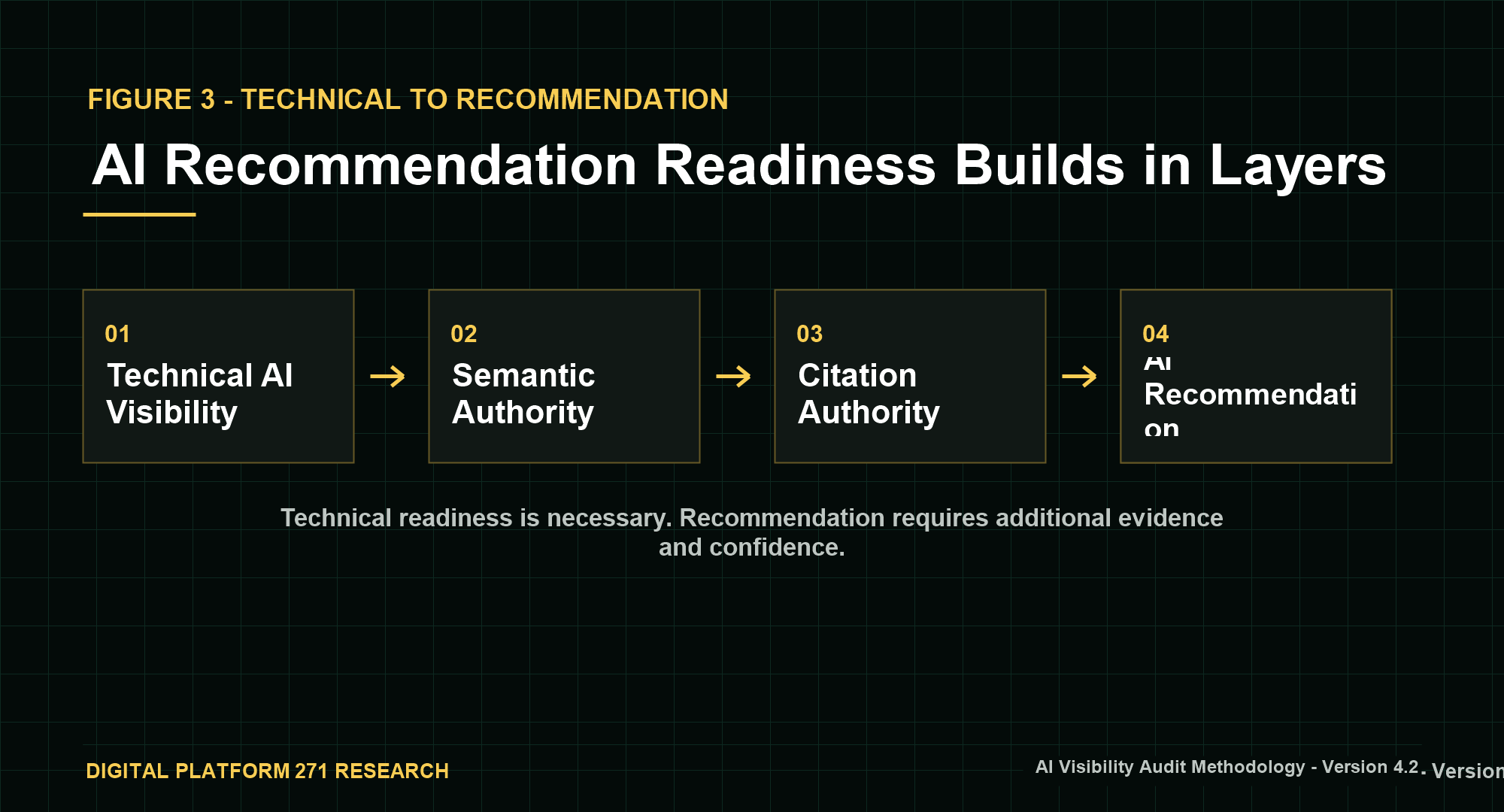
The methodology separates four connected layers:
- Technical AI Visibility: Can systems crawl, render, and interpret the website?
- Semantic Authority: Does the content clearly define the business, its topics, audiences, and relationships?
- Citation Authority: Are important claims supported by credible references, mentions, and corroborating evidence?
- AI Recommendation: Is there enough fit, proof, and confidence for an AI system to consider recommending the business?
Technical readiness is necessary, but recommendation depends on additional evidence and confidence. Read Why Technically Strong Websites Still Fail to Earn AI Recommendations for a deeper explanation of this gap.
Recommendation Testing
Real-world recommendation testing may be conducted across ChatGPT, Gemini, and Perplexity as a separate qualitative exercise.
Testing principles include:
- Use fresh sessions where practical.
- Ask unprompted category questions rather than leading brand-specific prompts.
- Record the first response.
- Record the date of testing.
- Note the model and search mode where possible.
- Interpret results qualitatively.
- Recognise that results may vary over time.
Recommendation testing is separate from the technical score. A platform response is a time-sensitive observation, while the audit score evaluates the website and public evidence available to support understanding and recommendation readiness.
What the Methodology Does Not Claim
- It does not guarantee recommendations.
- It does not predict rankings.
- It does not claim that structured data alone creates AI visibility.
- It does not claim that backlinks alone create recommendation trust.
- It does not treat a technical score as proof of recommendation visibility.
- AI outputs vary by prompt, platform, location, model version, search mode, and time.
- The methodology will evolve as new evidence and platform behaviour emerge.
Version History
Version 4.0
- Introduced the five-dimension scoring framework and recommendation-readiness evaluation.
Version 4.1
- Improved SPA and rendered-DOM evidence handling.
Version 4.2
- Improved evidence classification.
- Verified DOM-backed audience and answer-first content can now receive full credit.
- Weak keyword-only evidence remains capped at Partial.
Suggested Citation
Sarkar, S. (2026). AI Visibility Audit Methodology, Version 4.2. Digital Platform 271 Research.
https://www.digitalplatform271.com/research/ai-visibility-audit-methodology