AI discovery
Crawlability, rendering, indexing support, internal links and other signals that help machines reach the site.
Website readiness check
Evaluate the technical, semantic, citation and recommendation-readiness signals available on your website.
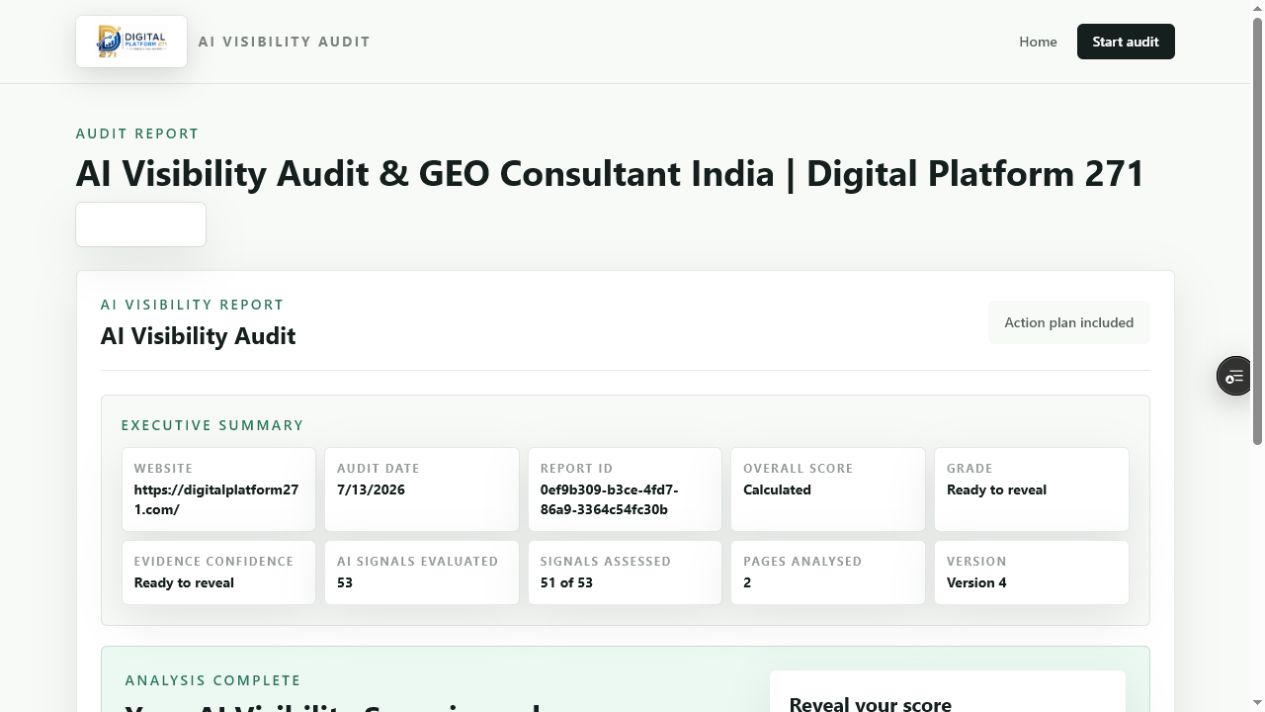
An AI Visibility Checker evaluates whether a website provides the technical, semantic and trust signals that can help AI systems discover and correctly understand a business. Digital Platform 271's checker analyses website signals related to crawlability, structured data, entity clarity, citation readiness and recommendation readiness.
It is a readiness assessment, not a view into a platform's private model, index or recommendation logic.
Up to 53 AI Visibility signals are evaluated, depending on the business model. Legitimate Not Applicable signals are excluded from the score denominator.
Crawlability, rendering, indexing support, internal links and other signals that help machines reach the site.
How clearly the website identifies the business, its offers, audience, people and market context.
Machine-readable Organization, Person, Service, WebSite and other relevant schema signals.
Direct explanations, useful answer blocks, service detail, audience context and topical coverage.
Identity, policies, contact evidence, references and authority signals that can support confidence.
Use cases, comparisons, proof, specifications and buyer-fit information that may support recommendations.
The AI Visibility Score summarizes website-readiness evidence across five dimensions: AI Understanding, AI Trust Signals, AI Discoverability, AI Recommendation Readiness, and Content & Entity Coverage.
External authority, consistent identity and citation evidence can also strengthen the signals available when AI systems generate citations or recommendations.
The checker evaluates public website evidence. It does not have access to private AI ranking or recommendation algorithms. It does not guarantee ChatGPT or Gemini inclusion, citations, recommendations, rankings, traffic or revenue.
Read the scoring methodologyStep 1
Submit the public website URL you want the existing AI Visibility Audit to examine.
Step 2
The audit reviews technical, semantic, trust, content and recommendation-readiness evidence.
Step 3
The free preview shows the overall score and high-level findings. The full paid report adds detailed evidence, recommendations and a PDF.
Being crawlable is not the same as being understood. Being understood is not the same as being supported by enough evidence to be cited or recommended.
Can AI and search systems reach, render and parse the website?
Can they correctly understand the business, offers, audience and entities?
Is there enough consistent evidence and external authority to support factual citation?
Is there enough reliable context to assess fit and recommend the brand with confidence?
| Area | AI Visibility Checker | SEO Audit |
|---|---|---|
| Primary goal | Assess readiness for AI discovery, understanding, citation and recommendation | Improve visibility and performance in traditional search results |
| Traditional search visibility | Reviews supporting technical and content foundations | Core focus |
| Entity understanding | Core focus | May be covered through semantic SEO and entity work |
| Structured data | Evaluates relevant machine-readable business and content signals | Evaluates search eligibility and enhanced-result support |
| AI citation readiness | Evaluates evidence, identity and authority context | Not usually a dedicated audit dimension |
| AI recommendation readiness | Evaluates buyer-fit, proof, comparisons and service or product clarity | Not usually a dedicated audit dimension |
| Technical SEO overlap | Includes crawlability, rendering, metadata, internal links and indexability signals | Deep technical search analysis |
AI visibility does not replace SEO. Strong SEO foundations often support AI discoverability.
The audit evaluates evidence across five scoring dimensions instead of relying on one technical check.
Signals that genuinely do not apply to a business model can be marked Not Applicable and removed from the score denominator, rather than being incorrectly counted as missing.
The score distinguishes technical access from semantic, citation and recommendation readiness.
Findings connect detected evidence to prioritized actions without claiming access to private AI algorithms.
Digital Platform 271's benchmark examined 30 Indian D2C brands across 53 AI Visibility signals and five scoring dimensions. The benchmark revealed that technical visibility and recommendation readiness are not the same problem. The study informs the measurement framework; it does not claim that an individual signal directly causes an AI recommendation.
Read the benchmark researchAn AI visibility checker evaluates website signals that can help AI systems discover, understand and assess a business. It reviews evidence such as crawlability, structured data, entity clarity, content, trust and recommendation readiness.
Enter your public website URL in the AI Visibility Audit. The checker analyses the available website evidence and produces an AI Visibility Score with high-level findings.
The AI Visibility Score is a readiness measure based on detected website signals. It summarizes technical, semantic, trust, discoverability, recommendation-readiness, and content and entity evidence.
The checker can assess whether your website provides signals that support AI discovery and understanding. It cannot inspect ChatGPT's private systems or guarantee that a brand is included in a specific answer.
The checker evaluates website-readiness signals relevant to AI discovery and understanding across systems such as ChatGPT, Gemini, Claude and Perplexity. It does not directly measure or guarantee placement inside any one AI platform.
No. The two overlap on crawlability, rendering, metadata and content foundations, but an AI visibility check also examines entity clarity, citation readiness and recommendation-readiness signals.
No. A high score indicates stronger website readiness evidence. It does not guarantee inclusion, citations, recommendations, rankings, traffic or revenue on any AI or search platform.
Start by improving crawlability, structured data, business identity, service or product clarity, answer-first content, internal links and credible authority signals. The audit prioritizes the gaps found on the submitted website.
No. AI visibility does not replace SEO. Strong SEO foundations often support AI discoverability, while GEO adds emphasis on entity understanding, answer usefulness, citation evidence and recommendation context.
Yes. The current scoring model can treat irrelevant physical-location signals as Not Applicable when sufficient evidence shows that a business operates online or remotely.
Recheck after meaningful technical, schema, content or authority changes. Periodic checks can also help identify new gaps as the website, business and public evidence evolve.
Run the AI Visibility Audit and see how your website performs across technical, semantic and recommendation-readiness signals.
Check My AI Visibility