
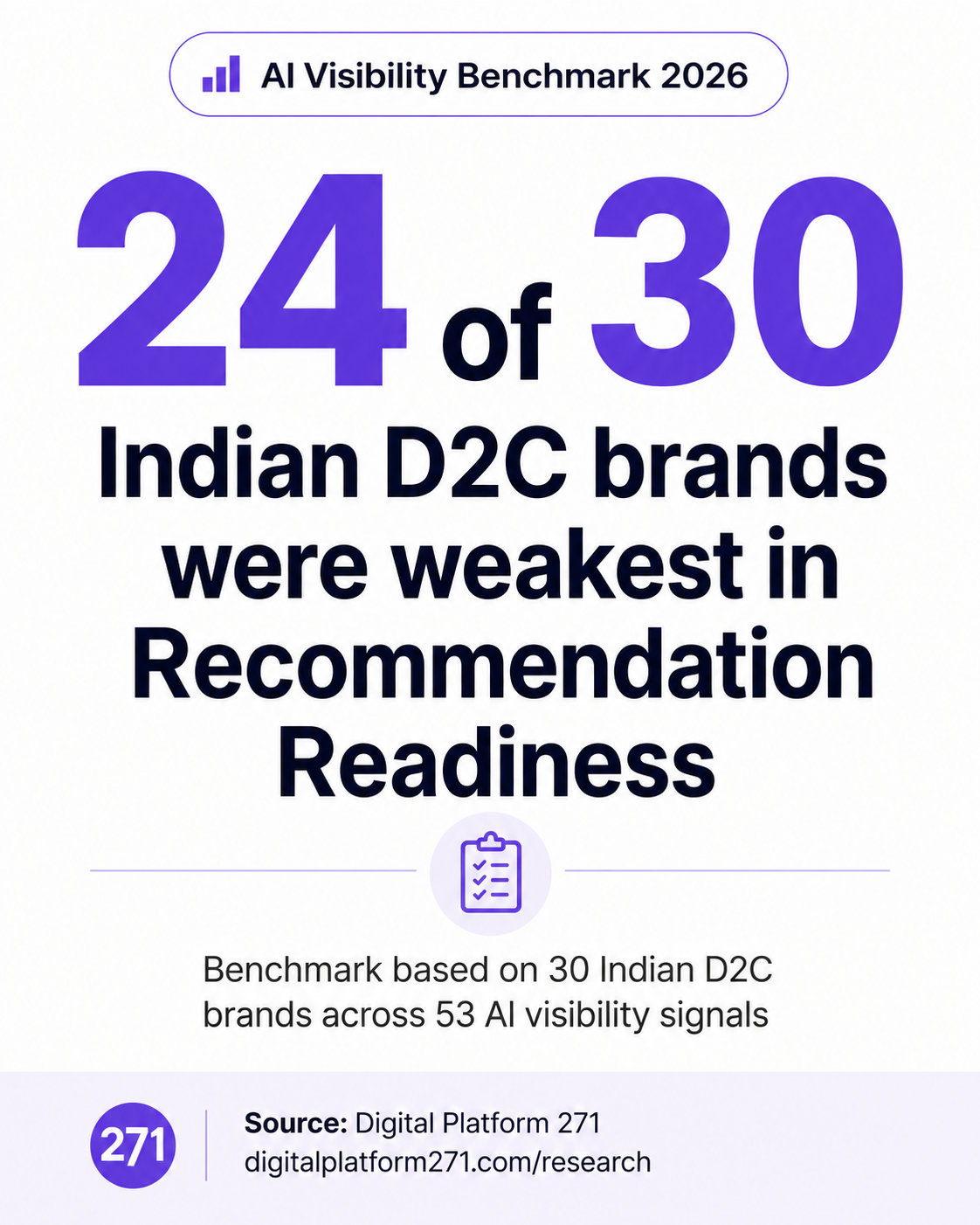
24 of 30 brands were weakest in Recommendation Readiness
Hero research graphic highlighting the main benchmark finding from the AI Visibility Benchmark 2026.
Benchmark Report
An Independent Study of AI Visibility Across Indian D2C Brands
Author: Sanchari Sarkar - Publication ID: DP271-AVB-2026-001 - Version 1.1 - Published 19 July 2026
For Journalists & Researchers
Use the original report, one-page summaries, DOI and ready-to-copy citation when referencing this benchmark. These resources are public and intended to make verification and attribution straightforward.
31-page PDF
Methodology, findings, charts, limitations and dataset context.
1-page PDF
Fast overview of the study and headline findings.
Press resource
Key statistics, methodology, citation details and press contact.
APA + BibTeX
Copy the DOI-backed citation or download the citation file.
Downloadable visuals
Publication-ready PNG graphics summarizing the benchmark's headline findings. Journalists, researchers, writers and creators may reuse them with attribution to Digital Platform 271 and a link to this original research page.
Hero research graphic highlighting the main benchmark finding from the AI Visibility Benchmark 2026.
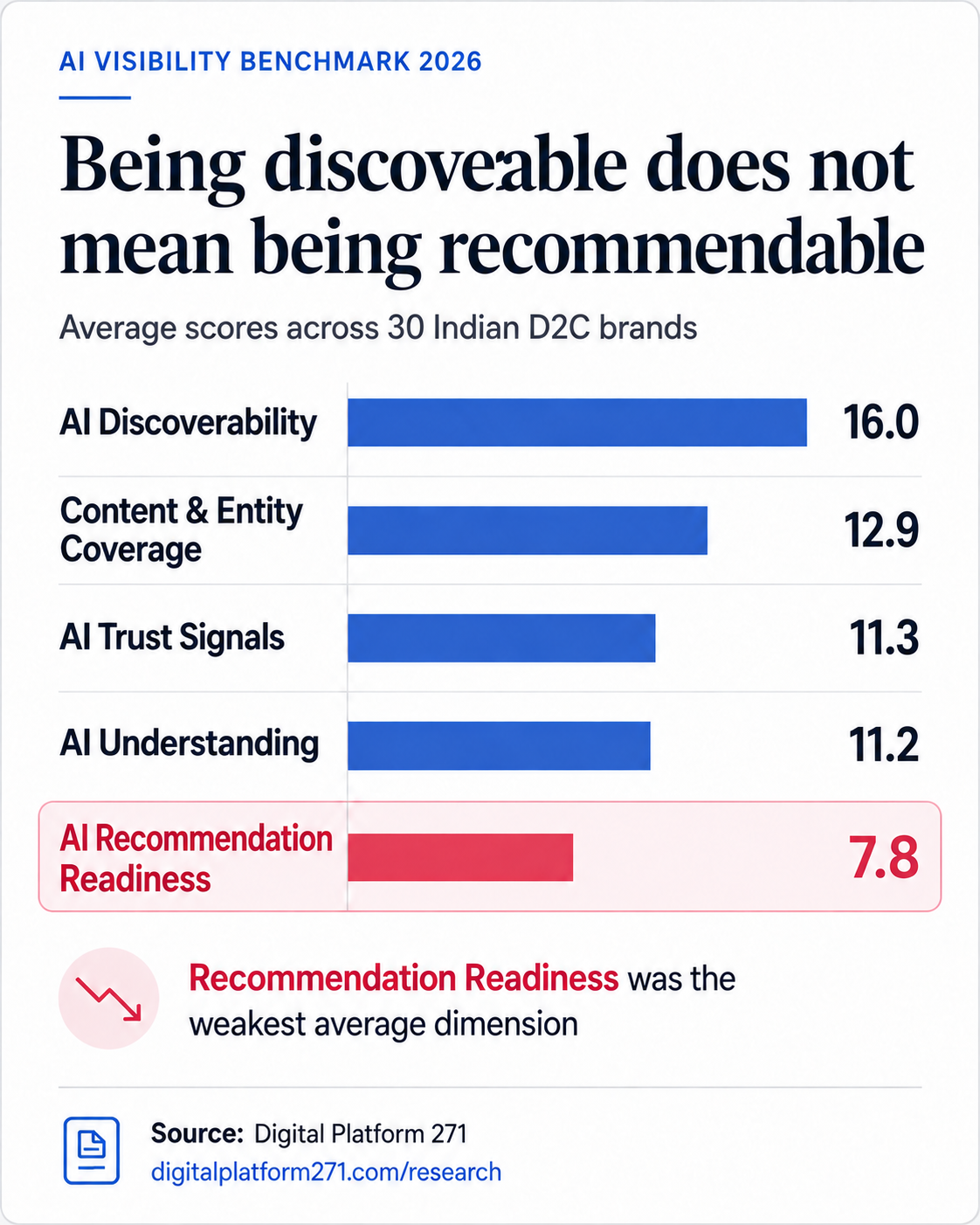
Comparison graphic showing the benchmark dimensions and the gap between discoverability and Recommendation Readiness.
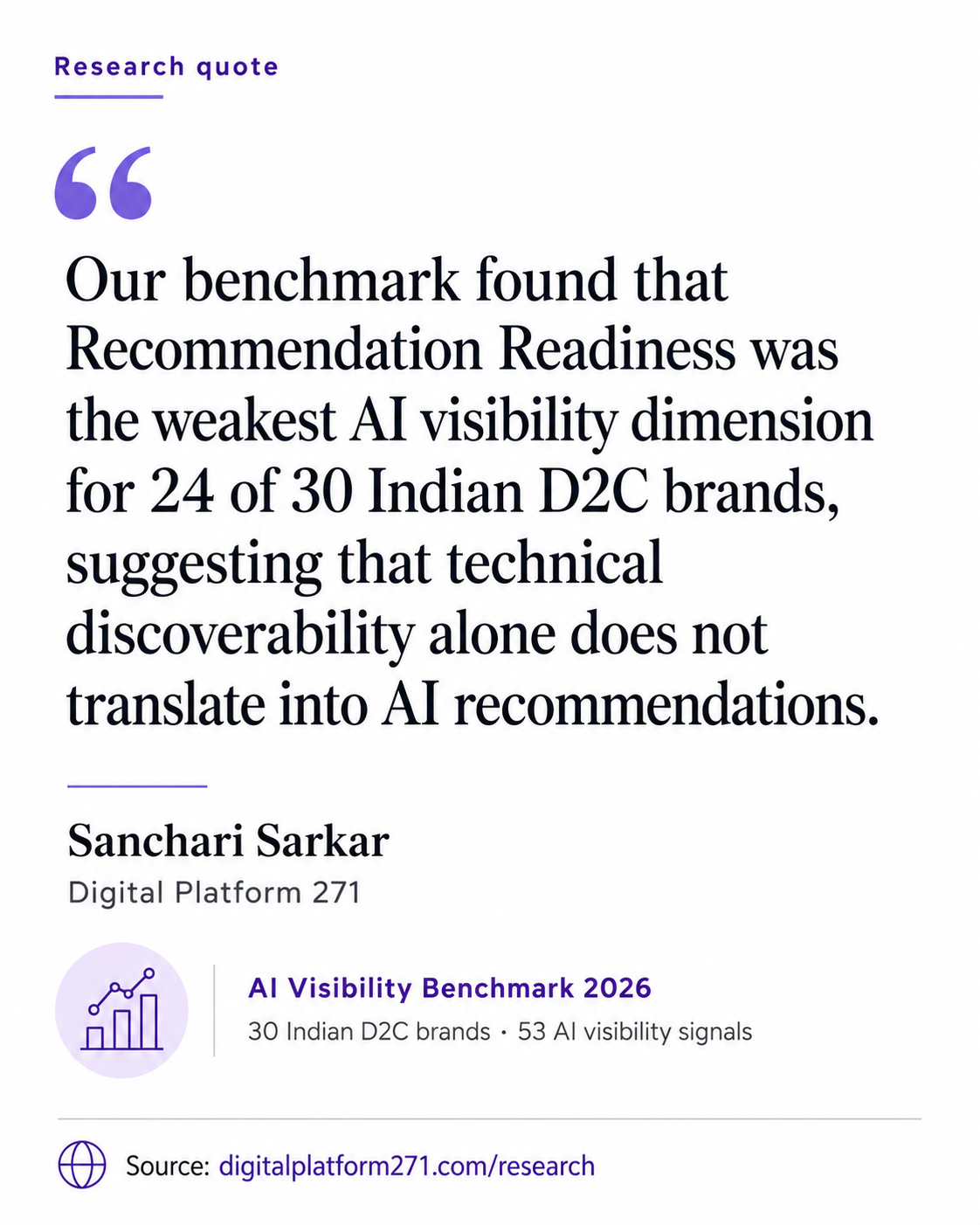
Quote card summarizing the benchmark insight for journalists, writers and creators.
Reuse credit: Digital Platform 271, AI Visibility Benchmark 2026. Please link to the original research page when publishing these visuals.
Research brief
Digital Platform 271 audited 30 Indian D2C and FMCG brand websites in July 2026 to evaluate observable website evidence relevant to how AI systems can discover, understand, verify, cite, and consider brands for recommendation using the proprietary AI Citation Readiness Framework™. The final Version 1.1 edition clarifies the methodology, research-at-a-glance figures, charts, citations, and publication metadata for public reference.
Average Overall Score was 59.3, median score was 63, highest score was 73, and lowest score was 13. The study should be interpreted as independent industry research for the audited sample, not as a peer-reviewed market-wide ranking.
Key Findings
Recommendation Readiness was the weakest measured dimension for 24 of 30 brands, or 80.0% of the sample.
AI Discoverability was the strongest measured dimension for 26 of 30 brands, or 86.7% of the sample.
The average Overall Score was 59.3 and the median Overall Score was 63.
No audited brand achieved Grade A or B in this single-pass benchmark.
Benchmark at a Glance
59.3
63
11.86
13-73
30
53
July 2026
India
Benchmark Charts
Observed average score for each AI visibility dimension.
Category maxima are not published in this edition, so values are shown as observed scores without an invented denominator.
Source: Digital Platform 271 benchmark, July 2026
Number and percentage of brands in each grade band.
Counts and percentages are displayed explicitly; counts are not treated as percentages.
Source: 30 audited brands
Strip plot of all 30 verified Overall Scores.
Dot positions show individual audited brand scores. Mean, median, minimum and maximum are shown below the plot.
Source: 30 verified overall scores
Two aggregate proportions observed in the benchmark.
Recommendation Readiness was weakest
80.0%
24 of 30 brands
Discoverability was strongest
86.7%
26 of 30 brands
These proportions describe the audited sample only and should not be interpreted as market-wide prevalence.
Source: Digital Platform 271 benchmark, July 2026
Dimension profile based only on observed sample averages.
This is not compared with an invented ideal brand and does not assume a published category maximum.
Source: Aggregate dimension averages
A practical way to organize AI visibility dimensions.
Conceptual model only. This diagram illustrates a useful way to organize AI Visibility dimensions and should not be interpreted as a statistically validated causal sequence.
Source: Digital Platform 271 methodology
Methodology
The study reviewed 30 public Indian D2C and FMCG brand websites.
Each website was audited once during July 2026 using the same proprietary framework.
The framework tracked 53 signals across five scoring dimensions.
Overall Score was calculated from dimension scores using the report methodology.
No repeated audits, formal confidence intervals, independent replication or signal-level public dataset are included in this edition.
Research Publication History
Version 1.0
Initial publication of the AI Visibility Benchmark 2026 research page and public assets.
Version 1.1
Conceptual Model
A conceptual structure for interpreting the benchmark.
Conceptual model only. This diagram illustrates a useful way to organize AI Visibility dimensions and should not be interpreted as a statistically validated causal sequence.
The study separates whether a brand can be discovered from whether it is positioned to be recommended. This distinction matters because technical crawlability alone does not establish entity confidence, attribution, evidence or answer readiness.
The model is used as an editorial framework for interpreting findings. It is not presented as a causal model or a statistically validated sequence.
Recommendations
Treat crawlability and recommendation readiness as separate objectives.
Audit missing signals at brand level before applying generic fixes.
Strengthen entity clarity, evidence and third-party trust signals.
Publish useful, attributable and answer-ready information.
Re-audit over time to measure change.
Limitations
Funding and Conflict Disclosure
Funding: This research was self-funded by Digital Platform 271.
Conflict disclosure: Lunepop, one of the 30 brands included in the benchmark, is affiliated with the report author. Its audit result was retained in the dataset and included in aggregate calculations. Lunepop received an Overall Score of 42 and Grade E.
Citation
Sarkar, S. (2026). AI Visibility Benchmark 2026 (Version 1.1). Digital Platform 271 Research. https://doi.org/10.5281/zenodo.22753158
@report{Sarkar2026AIVisibilityBenchmark,
  author = {Sanchari Sarkar},
  title = {AI Visibility Benchmark 2026},
  institution = {Digital Platform 271 Research},
  year = {2026},
  month = {July},
  version = {1.1},
  number = {DP271-AVB-2026-001},
  doi = {10.5281/zenodo.22753158},
  url = {https://doi.org/10.5281/zenodo.22753158}
}Author
AI Visibility Consultant, Digital Platform 271
Sanchari Sarkar develops practical frameworks and research for evaluating how brands are discovered, understood and recommended by AI-powered search and answer systems.
View profilePublisher
Digital Platform 271 Research is the independent research and publications division of Digital Platform 271. We publish original studies, benchmarks, and practical frameworks on AI Visibility, Generative Engine Optimization (GEO), AI Commerce, and AI-driven digital discoverability. Our research helps businesses understand how AI systems discover, interpret, and recommend brands in the emerging era of AI-powered search.
Press contact: marketing@digitalplatform271.com.
References
Download Research Assets
Access the full benchmark report, executive summary, and media fact sheet as public PDF resources from Digital Platform 271 Research.
Complete 31-page report with methodology, findings, charts, limitations and the audited 30-brand dataset.
One-page summary of the study, headline findings, methodology boundaries and implications.
One-page press resource with headline findings, key statistics, methodology, citation information and press contact.
ZENODO
Permanent DOI-backed public record of the benchmark for researchers, journalists and other citation use.
JSON
Canonical citation metadata, headline findings, methodology boundaries and source links in machine-readable JSON.
CSV
Machine-readable CSV containing the verified 30-value Overall Score series used in the published benchmark.
JSON
Machine-readable aggregate statistics, dimension averages, grade distribution and headline benchmark proportions.
GITHUB
Browse the public dataset documentation, methodology, citation metadata, CSV and JSON files on GitHub.
Footer Research Metadata
See How Your Brand Compares
Compare your website against the benchmark methodology used in this research.