Why Technically Strong Websites Still Fail to Earn AI Recommendations
By Sanchari Sarkar, Digital Platform 271
Version 1.0
Last updated: 1 August 2026
Estimated reading time: approximately 10–12 minutes
This article may be updated as Digital Platform 271 expands its benchmark research and records changes in its own AI recommendation visibility.
I audited my own website before offering AI Visibility services to clients.
The result surprised me.
Digital Platform 271 scored 84 out of 100 on its technical AI Visibility Audit, earning a Grade B. The result indicates a comparatively strong technical foundation within the Digital Platform 271 AI Visibility framework, with solid performance across core technical signals such as crawlability, structured data, entity clarity, and metadata.
Recommendation visibility in unprompted category searches across ChatGPT, Gemini, and Perplexity (as tested on 1 August 2026): not yet.
Results may vary by prompt wording, location, model version, search mode and testing date. The first response from each fresh conversation was recorded.
That gap is the subject of this article. It is not a confession of failure — a technical score of 84 is, by design, not supposed to produce recommendations on its own. It is a demonstration of a distinction that the GEO (Generative Engine Optimization) industry has not yet articulated clearly enough: technical AI visibility and AI recommendation are two different problems, solved by two different kinds of evidence.
Key TakeawayA technical AI Visibility Score measures whether AI systems can access, parse, and understand a website.
It does not measure whether those systems have enough independent evidence to trust and recommend the business.
Technical understanding and recommendation confidence are different problems.
Table of Contents
- The Misconception
- What Technical AI Visibility Actually Measures
- What AI Recommendation Systems Actually Need
- Semantic Authority
- Citation Authority
- Why Technically Strong Websites Still Fail
- Lessons from Digital Platform 271
- What the Broader Pattern Looks Like
- What This Article Does Not Claim
- Practical Recommendations
- How the AI Visibility Audit Uses This Framework
- Conclusion
The Misconception
Most businesses entering the AI search era carry over an assumption from the SEO era: if the technical foundation is strong enough, visibility follows. Fix your crawl errors, add your schema, clean up your metadata, and the algorithm rewards you.
That assumption was never fully true in classic SEO — content quality and backlinks always mattered more than technical hygiene alone — but it was closer to true, because search engines were largely retrieval systems. Rank well, appear in results, and the user decides.
Generative engines do not work this way. When ChatGPT, Gemini, or Perplexity answer a question like "what's a good makhana snack brand" or "which D2C skincare brand should I try," they are not returning a ranked list for the user to evaluate. They are making a recommendation on the user's behalf, in their own words, with their own implied endorsement attached. That is a categorically different act, and it requires a categorically different kind of evidence.
A technically strong website tells an AI system: I can read and understand you. It does not tell the AI system: you should trust me enough to vouch for this business to a stranger. Confusing these two signals is the misconception at the center of most GEO advice being published today.
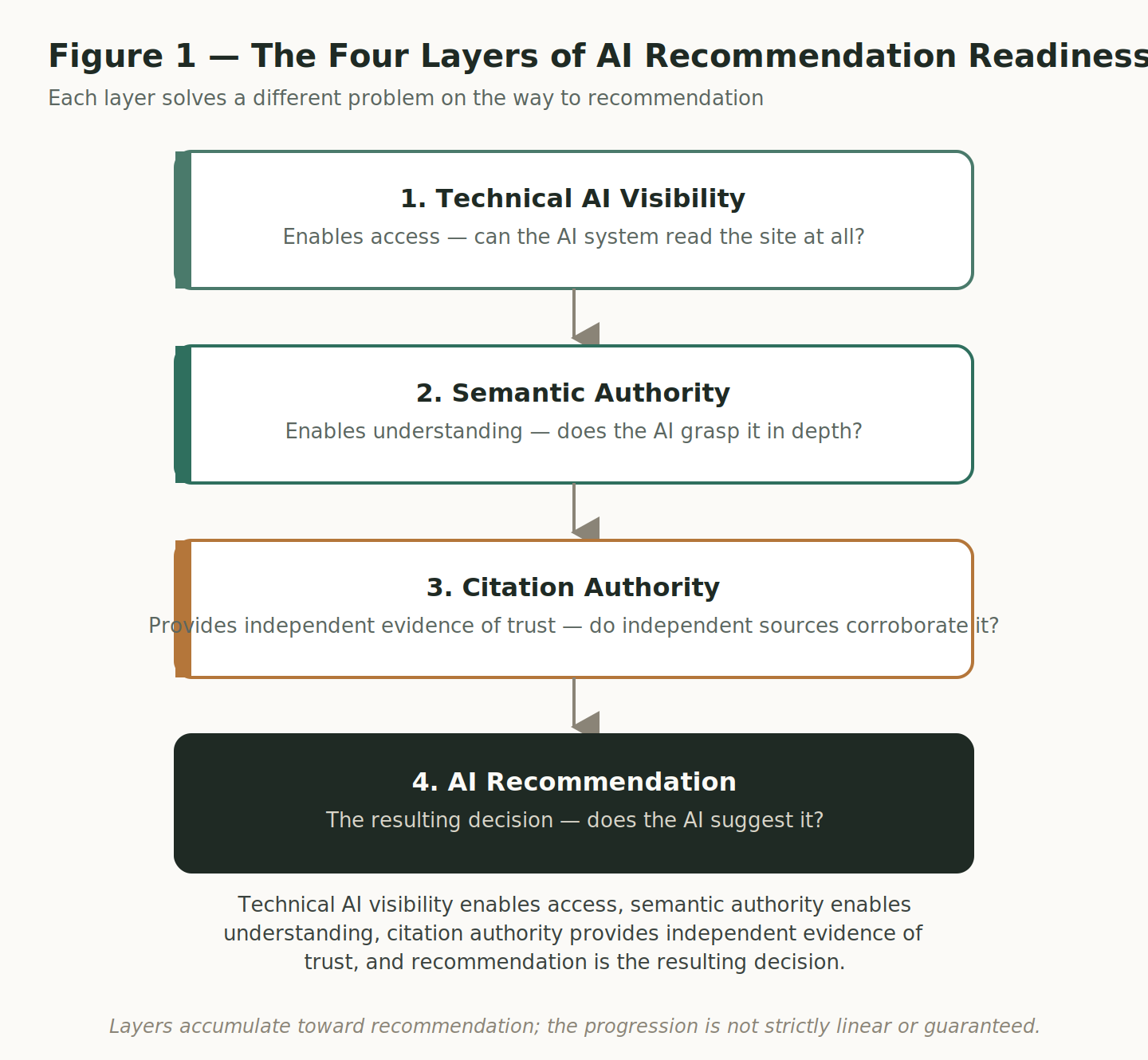
Each layer solves a different problem. Technical AI visibility enables access, semantic authority enables understanding, citation authority provides independent evidence of trust, and recommendation is the resulting decision. The four layers are presented in sequence because each depends on the one before it — but progress through them is not strictly linear, and clearing one layer does not guarantee advancing to the next.
What Technical AI Visibility Actually Measures
Technical AI visibility is the machine-readability layer. It answers one question: can an AI system efficiently parse, understand, and correctly categorize this website at all?
It typically covers:
- Crawlability — whether AI crawlers and retrieval systems can access and render the site's content without obstruction
- Metadata — accurate titles, descriptions, and Open Graph data that summarize each page correctly
- Structured data — schema markup (Organization, Product, FAQ, Article, etc.) that lets AI systems extract facts rather than infer them
- Entity clarity — whether the business, its offerings, and its category are unambiguously defined, so the AI does not have to guess what the site is "about"
- Technical accessibility — page speed, mobile rendering, absence of JavaScript-dependent content that hides text from non-browser retrieval
- Internal structure and semantic organization — whether the site's information architecture reflects logical topic relationships rather than a flat pile of pages
A high technical score means an AI system can see the business clearly. It says nothing about whether the AI system has any reason to believe the business is a good answer to a user's question. Legibility is not the same as credibility.
This is also why a technical score should not be marketed as an "AI visibility score" in the broader sense the phrase implies. It is one input, not the output.
Table 1: Technical AI Visibility vs. AI Recommendation
| Technical AI Visibility | AI Recommendation |
|---|---|
| Measures machine readability | Reflects recommendation confidence |
| Relies mainly on website-controlled signals | Relies on website and external evidence |
| Includes crawlability, schema, metadata and entity clarity | Includes semantic depth, corroboration, reputation and contextual relevance |
| Can often improve through technical implementation | Usually develops over a longer period |
| Helps AI understand the business | Helps AI decide whether to suggest the business |
Technical readiness is necessary because an AI system cannot recommend a business it cannot understand, but readability alone does not establish trust.
What AI Recommendation Systems Actually Need
Recommendation is a trust decision, and trust decisions in generative engines are built on evidence the system has gathered about a business from sources it does not control. This evidence tends to fall into two distinct categories, and conflating them is a common source of error in GEO strategy.
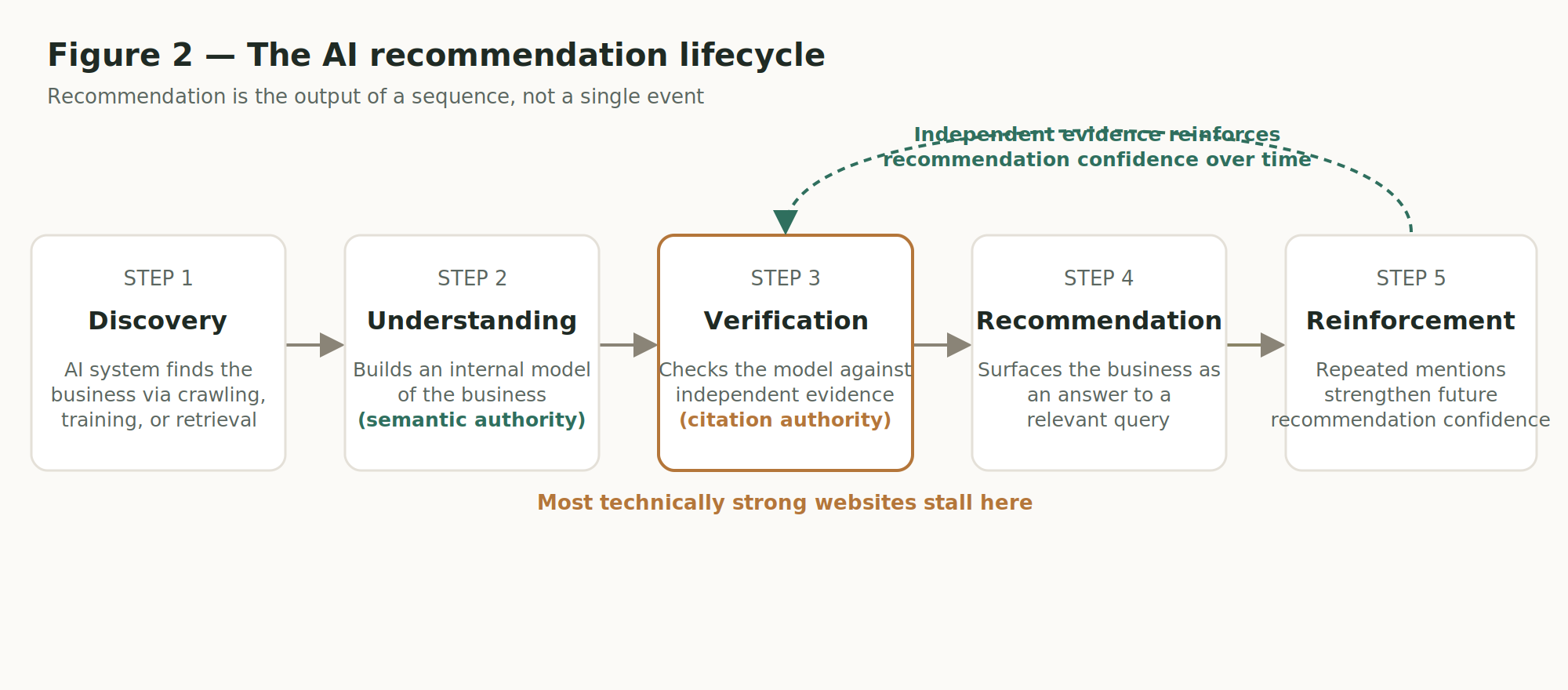
Recommendation is not a single event — it is the output of a sequence an AI system moves through each time it evaluates whether to name a business as an answer: Discovery, Understanding (semantic authority), Verification (citation authority), Recommendation, and Reinforcement, which feeds back into Verification over time.
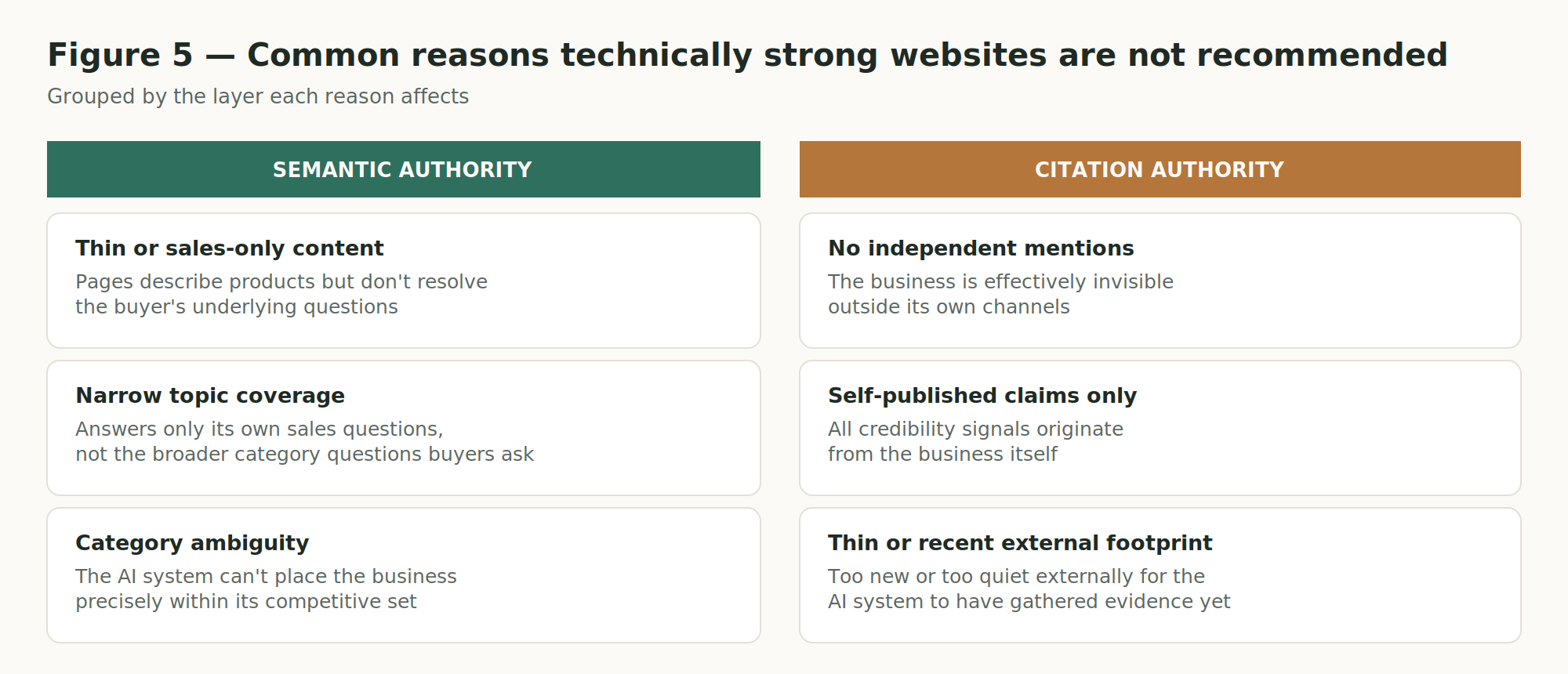
Most technically strong but under-recommended businesses complete Discovery and Understanding reliably and stall at Verification, because that step depends on evidence they cannot generate from inside their own site.
Semantic Authority
Semantic authority is depth and clarity of understanding — whether the AI system has a rich, internally consistent picture of what a business does, who it serves, and how it compares to alternatives. It is built from:
- Topic coverage — does the site (and the wider web presence around it) address the full range of questions a buyer in this category would ask, or only a narrow slice?
- Answer quality — do individual pages resolve specific questions clearly and directly, in a form that can be lifted into a generated answer?
- Context and relationships between pages — does the site connect related concepts (a product, its use case, its category, its comparisons) so the AI can reason about them, rather than treating each page as an isolated fact?
- Entity understanding — can the AI system place the business correctly within its category, distinguishing it from adjacent or competing entities?
- Depth and clarity — is the content substantive enough to answer follow-up questions, or does it stop at surface-level description?
Semantic authority is largely something a business builds through what it publishes and how it structures that content over time. It is earned through completeness and precision, not through a single audit fix.
Citation Authority
Citation authority is external corroboration — evidence that other, independent sources on the web treat the business as real, credible, and worth mentioning. It is built from:
- Editorial mentions — coverage in independent publications, not the business's own channels
- Credible backlinks — links from sites the AI system's training and retrieval processes already treat as trustworthy
- Industry references — mentions in category-relevant directories, comparisons, or roundups
- Reviews — third-party evaluation, particularly on platforms with enough volume and consistency to read as a genuine signal
- Brand mentions — the business being named in conversation across the web, independent of whether a link is attached
- Research references — citations of the business's own data, studies, or claims by other sources
Citation authority cannot be self-generated in the way technical fixes or on-site content can. It requires the business to exist credibly in other people's content, which is slower, harder, and less directly controllable — and precisely because of that, it carries more weight in a recommendation decision. An AI system has no reliable way to distinguish a business's own claims about itself from the truth. External, independent evidence is one of the few signals it can treat as harder to fake.
Semantic authority and citation authority are frequently merged into a single vague category called "authority" in GEO commentary. They should not be. A business can have excellent semantic authority — clear, thorough, well-organized content — and still have almost no citation authority, because no one outside the business has written about it yet. The reverse is also possible: a business can be widely mentioned externally while its own site does a poor job of explaining itself. Each deficiency requires a different fix.
Why Technically Strong Websites Still Fail
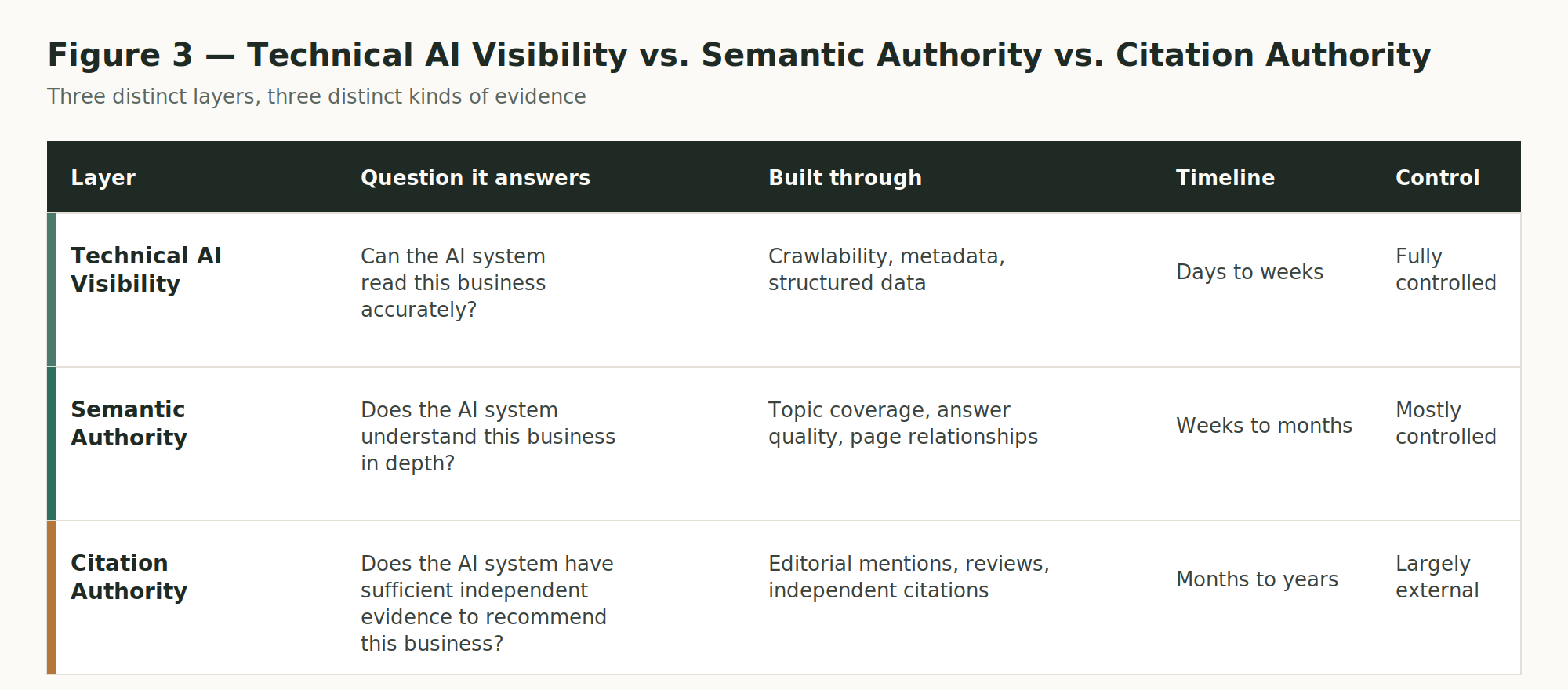
Put the three layers together and the pattern becomes clear:
Technical AI visibility determines whether an AI system can read the business accurately.
Semantic authority determines whether the AI system understands the business well enough to describe it correctly.
Citation authority determines whether the AI system has independent evidence to vouch for the business to someone else.
A technically strong website satisfies only the first condition. It removes the friction that would otherwise prevent an AI system from understanding the business at all — but it does nothing to manufacture the external evidence a recommendation requires. This is why a site can score well on a technical audit and still be absent from category recommendations: the audit measured readability, not trustworthiness.
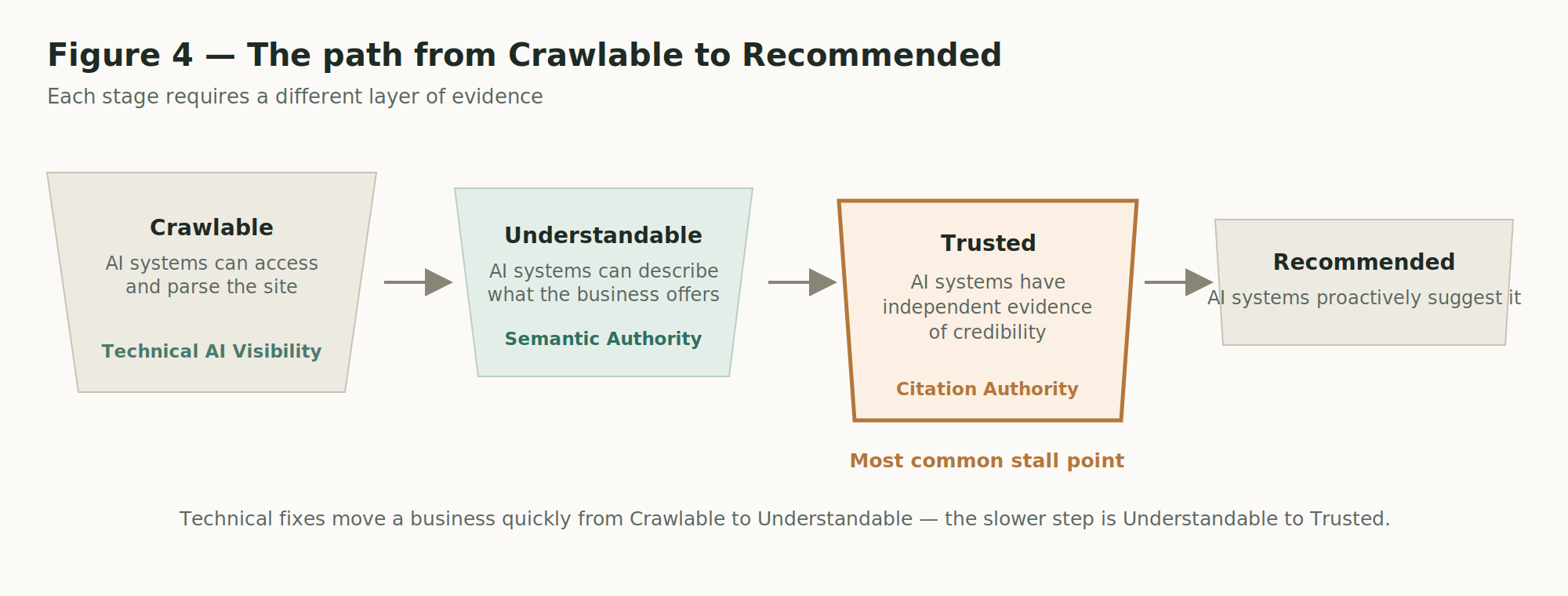
A business moves through this path left to right. Technical fixes advance it from Crawlable to Understandable relatively quickly. The harder, slower transition — the one most technically strong websites never complete — is from Understandable to Trusted, because that step depends on evidence the business does not generate itself.
Key Insight: Entity Clarity Is Not Entity TrustEntity clarity tells an AI system what the business is.
Entity trust gives the system evidence that the business may be a credible option within its category.
Structured data and clear content can improve entity clarity relatively quickly. Entity trust depends more heavily on sustained, independent evidence.
This also explains why AI retrieval and AI recommendation are different capabilities, even though they are frequently discussed as one. Retrieval is the AI system's ability to find and surface relevant information about a business when asked directly — it is closer to what classic search indexing does. Recommendation is the AI system's willingness to proactively suggest the business as an answer to a broader, less specific question, where the user has implicitly delegated the evaluation to the AI. A business can be retrievable without being recommendable. Most technically optimized but under-cited businesses sit exactly in this gap.
Lessons from Digital Platform 271
Applying this framework to Digital Platform 271's own audit result clarifies what an 84/100 technical score actually represents, and what it does not.
The score confirms that the technical layer is largely in place: the site is crawlable, its structured data is implemented, and its entity is clearly defined for AI systems to interpret. This provides a strong technical foundation for AI understanding, but it represents only one stage in the broader process of becoming recommendation-ready.
What the score does not confirm is semantic depth across the full range of questions a founder in this category might ask, or a body of independent citation evidence built up over time. Both are earlier-stage relative to the technical work, not because they were neglected, but because they operate on a different timeline. Technical fixes can be shipped in a sprint. Citation authority accumulates over months, through genuine external engagement — coverage, mentions, references — that cannot be manufactured on demand.
This is not a special case. It is the expected shape of the problem for most technically capable, newer digital businesses.
What the Broader Pattern Looks Like
This distinction is not specific to one business. Digital Platform 271 evaluated 30 Indian D2C brands across 53 AI visibility signals spanning five evaluation dimensions, published as the AI Visibility Benchmark Report 2026. Rather than fabricate precision the underlying data doesn't support, the honest summary is this: the benchmark identified a recurring pattern rather than a single definitive statistic. Several brands demonstrated comparatively stronger technical readiness than recommendation readiness, suggesting that technical optimization alone is often insufficient to establish the external evidence required for AI recommendation. The gap this article describes reflects that recurring pattern.
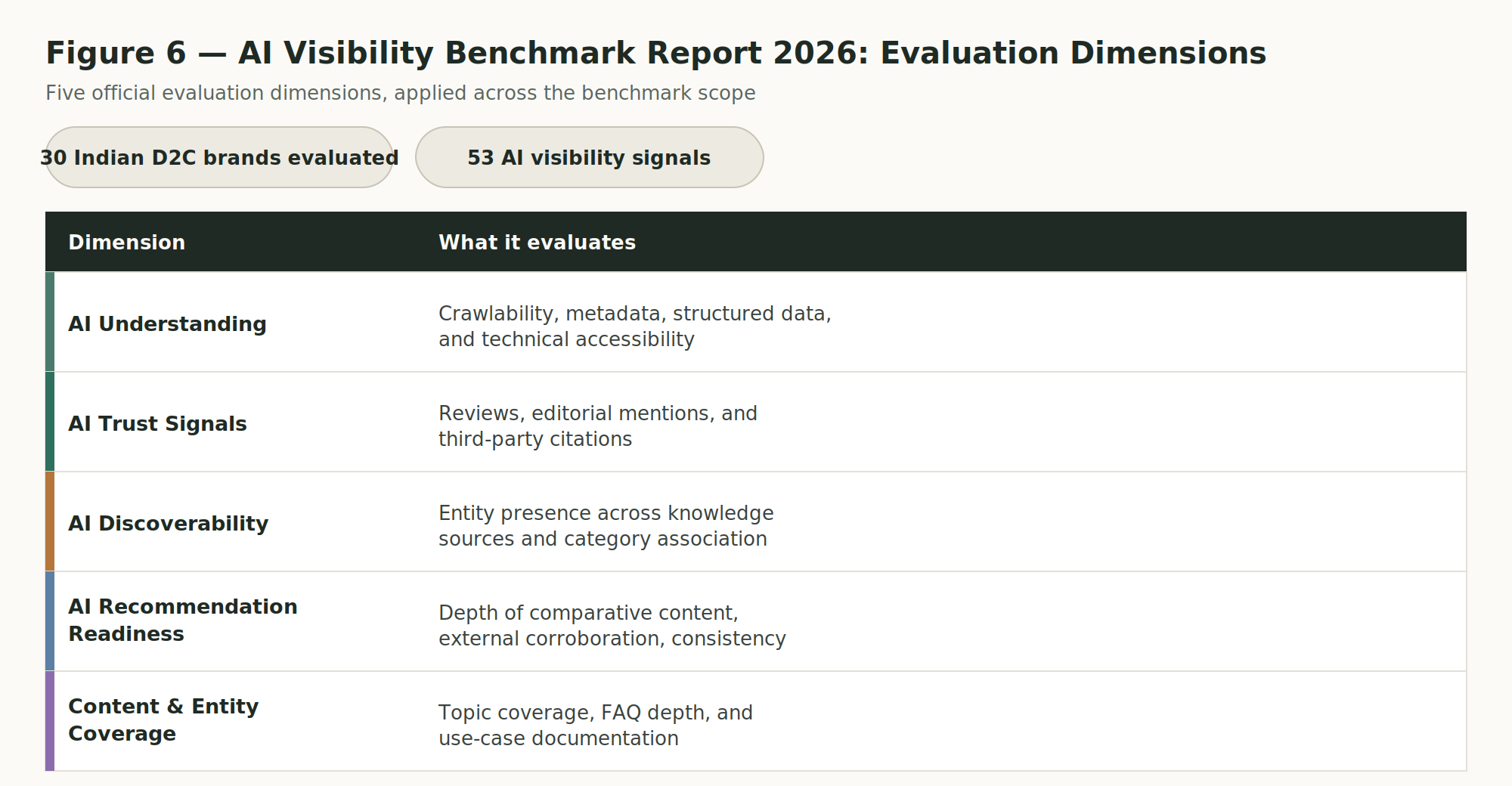
The benchmark evaluates multiple dimensions rather than treating AI visibility as a single technical score. The 53 signals are distributed unevenly across these five dimensions; the benchmark treats the dimension-level pattern, not the raw signal count, as the primary finding.
The benchmark's five evaluation dimensions are broader measurement categories. The technical, semantic and citation framework used in this article is an interpretive model for explaining how those signals contribute to recommendation readiness.
What This Article Does Not Claim
This article draws a distinction between technical readiness and recommendation readiness. It does not extend that distinction into promises. To be precise about the limits of what has been shown here:
- Structured data does not guarantee an AI recommendation.
- A high technical score does not guarantee visibility in ChatGPT, Gemini, or Perplexity.
- Backlinks alone do not create recommendation trust.
- Technical optimization does not replace semantic depth or external credibility.
- No business can guarantee that an AI system will recommend a specific brand.
- Recommendation visibility may vary across prompts, locations, model versions, retrieval systems, and time.
These limitations are part of the argument, not a disclaimer appended to it. The central claim of this article is that recommendation depends on accumulated, independent evidence rather than any single fix — and that claim would be undermined by implying the opposite anywhere else in the piece.
Practical Recommendations
For a founder or marketing leader trying to prioritize AI visibility work, the sequencing that follows from this framework is:
- Resolve technical AI visibility first, but treat it as table stakes. It is necessary and comparatively fast to fix, but it should not be mistaken for the finish line, and it should not be marketed to stakeholders as if it were.
- Audit semantic depth, not just technical structure. Ask whether the site's content actually answers the full range of questions a prospective buyer — or an AI system synthesizing an answer for one — would need resolved. Thin, sales-oriented pages rarely satisfy this requirement, even when the schema behind them is technically correct.
- Treat citation authority as a distinct, longer-horizon workstream. This means genuine outreach for editorial coverage, participation in category-relevant conversations, and building a track record of third-party mentions — not link-building in the SEO sense, but reputation-building in a form AI systems can detect.
- Separate the two "authority" workstreams internally. Assign different owners, different timelines, and different success metrics to semantic authority (a content and information-architecture problem) and citation authority (a PR and external-relations problem). Bundling them under one vague "authority" initiative tends to produce work that improves neither.
- Re-audit periodically, but expect technical scores to plateau while recommendation outcomes lag behind. A technical score plateauing at a strong level while recommendation visibility is still developing is not a sign that the work has failed — it is a sign that the business has moved into the slower, evidence-accumulation phase of the problem.
Digital Platform 271's own AI Visibility Audit applies this same three-layer distinction — technical, semantic, and citation — when evaluating a brand's current position, rather than collapsing everything into a single score.
How the AI Visibility Audit Uses This Framework
The Digital Platform 271 AI Visibility Audit evaluates a business across three complementary layers: Technical AI Visibility, Semantic Authority, and Citation Authority. Each layer is assessed separately because each answers a different question about recommendation readiness. This structure exists to explain why a business may be understood by AI systems without yet being recommended by them — not to reduce that assessment to a single technical score.
Conclusion
Improving technical AI visibility is the beginning of becoming discoverable by AI systems — not the end. A technically sound website creates the foundation an AI system needs to understand a business accurately. But long-term recommendation depends on something a technical audit cannot manufacture: semantic clarity built through genuinely useful content, and credible external evidence accumulated through sustained, independent authority in the wider web.
Technical readiness allows AI systems to access and understand a business. Semantic authority helps them understand the business in depth. Citation authority provides independent evidence that the business is credible. Recommendation is not produced by one technical fix. It emerges from accumulated, consistent evidence.
Understanding can be engineered. Trust has to be earned.
Related Research and Tools
This article draws on two ongoing bodies of work at Digital Platform 271:
- The AI Visibility Benchmark Report 2026, which evaluates 30 Indian D2C brands across 53 AI visibility signals spanning five dimensions.
- The Digital Platform 271 AI Visibility Audit, which applies the technical, semantic, and citation distinction described in this article to an individual brand's current position.
- The AI Visibility Audit Methodology, which explains the five dimensions, evidence types, scoring principles, and limitations behind the assessment.