
AI Visibility Weekly · Google AI Search
Google Just Clarified How to Optimize for AI Search. Most Brands Are Fixing the Wrong Things.
Google’s guidance makes one thing unusually clear: there is no secret AI-only technical shortcut. The harder question is whether your website gives AI systems enough clear, specific and trustworthy information to use once they find you.
I’ve spent the last few weeks going back and forth with founders about what Google’s new AI search guidance actually means for them. And almost every conversation starts the same way.
“So do we need llms.txt now?” “Should we be writing content differently for AI?” “Is there some new schema we’re missing?”
No, no, and no. But that’s not really the interesting part.
Google published an official guide to optimizing for generative AI features on Search. It is one of the clearest, most on-record explanations of what Google says matters for AI Overviews and AI Mode. The guidance reinforces that existing SEO fundamentals remain relevant and that there are no additional technical requirements or special AI-only optimizations required for inclusion.
SEO gets you retrievable. It doesn’t get you recommended.
Here’s the distinction I think most brands are missing. Google is saying that its AI features are built on the same core ranking and quality systems as regular Search. They use retrieval-augmented generation, meaning the AI pulls from pages that are already indexed and eligible to show up in results.
So if your site has crawlability issues, thin content, or technical problems that keep it out of regular search, no amount of AI-specific tinkering is going to fix that. You have to be found before you can be cited.
But SEO alone doesn’t solve what happens after retrieval. Once a page is available, the system still has to determine whether the information is clear enough, specific enough and trustworthy enough to use in an answer. Retrievability is about whether the door is open. What happens once someone walks through it is a separate question.
There’s no magic AI markup, and a lot of people needed to hear that.
Google’s guidance directly addresses something I get asked constantly: whether there is some special file, schema, or AI-only markup that unlocks visibility. There isn’t.
You don’t need a separate AI text file. You don’t need to chunk your content differently for machines. Structured data still helps, but only when it matches what is actually on the page.
I saw this play out with a client a while back. Beautiful schema. Every field filled in, price, availability, product type, all technically perfect. But the actual page copy was vague marketing language, and half the claims in the schema weren’t backed up anywhere visible. The structured data was basically making promises the page itself couldn’t keep.
That is not an AI visibility strategy. It is a mismatch waiting to get caught.
Generic content isn’t giving AI anything to work with.
This is the part that matters most for D2C brands specifically. AI systems do not need another version of information that is already sitting on five hundred other websites.
If your blog has “5 Benefits of Vitamin C” and so does every other skincare brand’s blog, there is nothing there that makes your page uniquely useful as a source.
What gives a system something distinctive to retrieve is evidence nobody else has. A skincare brand testing its own 10% Vitamin C serum on 40 people over 30 days and writing up what happened, that’s a source. A makhana brand explaining exactly where its raw material comes from, how it is graded, how it is processed and what quality checks it goes through before packaging, that’s a source too.
The difference is between restating a category fact and contributing something original to it.
Product pages are quietly becoming data infrastructure.
A product page used to have one job: convince a human to buy. Now it also has to function as a clean, factual reference for systems helping people compare options.
Price, availability, ingredients, specifications, real customer feedback, shipping terms and return policy all need to be stated plainly, not buried in a PDF or implied through vague copy.
I want to be careful here, because this does not mean AI systems are constantly pulling live inventory data from every site or making purchase decisions on a user’s behalf. It means that when a system is trying to answer a comparison-heavy question, brands with clear, explicit facts are easier to evaluate than brands that make the system guess.
This is closely related to AI Recommendation Readiness: whether a page provides enough decision-useful evidence for a brand to be evaluated as an option.
And a lot of real questions are comparison questions.
Google’s guidance discusses query fan-out. The idea is simple once you strip the jargon out.
When someone asks a useful question such as “which high-protein snack under ₹300 is good for someone trying to cut sugar,” the system may need to resolve several smaller questions: protein content, sugar content, ingredients, price, customer feedback, brand credibility and availability.
If your website only answers the marketing version of who you are, warm, aspirational, on-brand, but never states the actual protein-per-serving or sugar-per-serving numbers clearly, you have made yourself harder to use for exactly the kind of specific, high-intent query AI search is good at handling.
If I were auditing a D2C website today, here’s what I’d check first.
Not a long checklist. Just five questions, in order of how much they tend to matter.
Can AI clearly tell what the company actually is and what it sells, without piecing it together from taglines?
Are specific product attributes, ingredients, dimensions or materials written out clearly rather than only implied?
Are claims such as “clinically tested” or “sustainably sourced” backed by visible evidence?
Does your structured data say the same thing your page copy says?
Can price, availability and policy information be found in seconds, not minutes?
Every one of these fails for the same underlying reason. Somewhere, the brand is asking a visitor, or a machine, to trust it without giving them enough to trust it with.
The questions underneath all of this
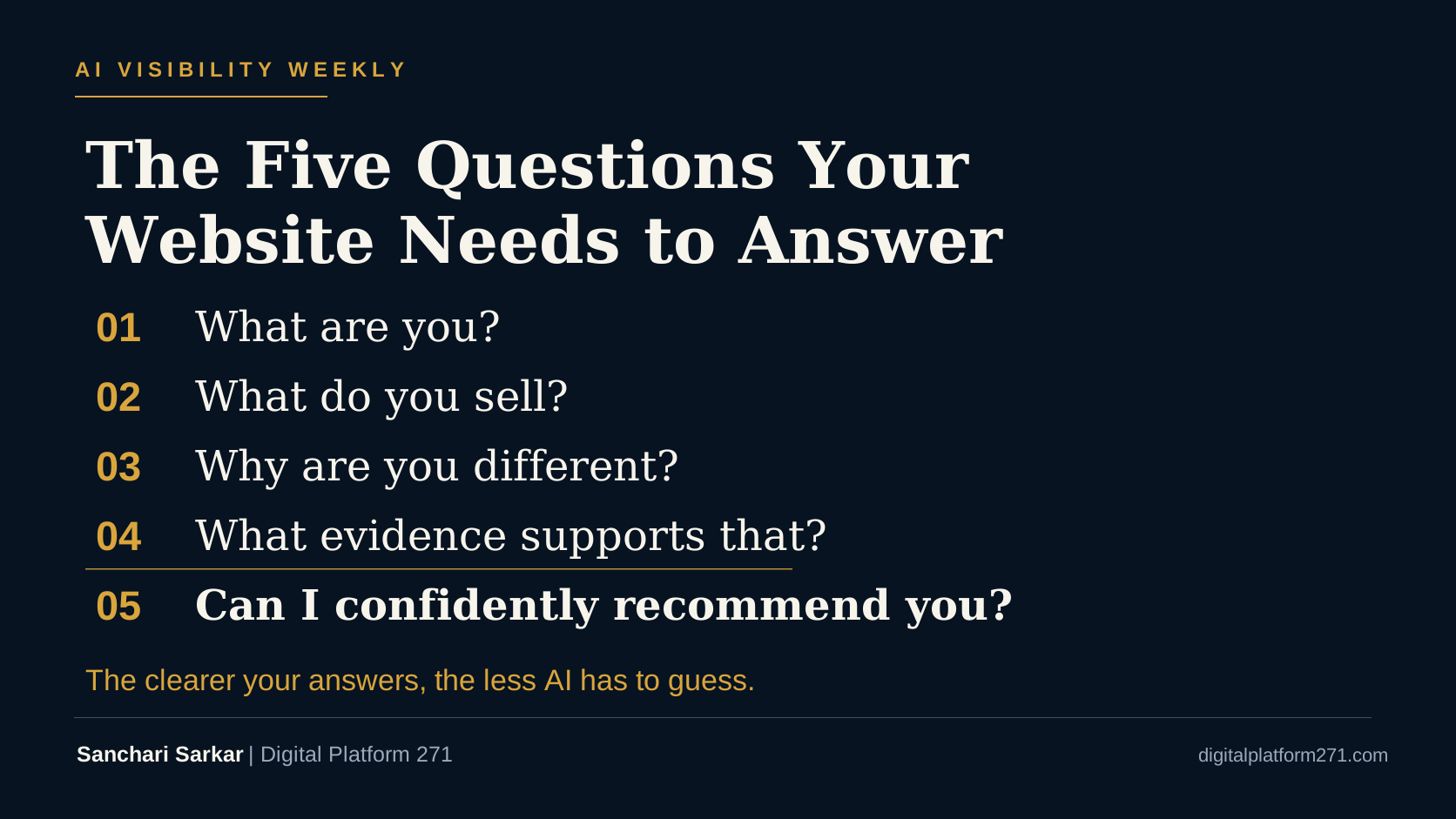
What are you? What do you sell? Why are you different? What evidence backs that up? Can I confidently recommend you?
If your website answers all five clearly, you are in a much stronger position, regardless of which AI system is doing the looking. If it cannot answer even two or three, that is the actual audit before you touch another line of schema.
One important caveat
None of this guarantees that you will be cited in ChatGPT, recommended in Gemini, or featured in an AI Overview. Different systems retrieve, rank and ground information differently, and Google’s guidance only tells us how Google’s own systems work.
What this improves is the quality and clarity of the evidence available about your brand. That helps reduce guesswork, even though no single website change can guarantee an AI citation or recommendation.
If you want to examine whether the claims and evidence on your own website are easy for AI systems to evaluate, see AI Citation Readiness and the broader Generative Engine Optimization in India guide.
AI visibility might turn out to be less about optimizing a website for robots, and more about finally building a website that doesn’t leave so many questions unanswered.
If a system has to guess what your product does, who it is for, why your claims are true, or how you compare with the brand next to you, that guesswork does not disappear. It becomes your visibility problem.
If you looked at your own website through this lens today, what would AI still have to guess about your brand?
Next step
Audit what AI can actually verify about your brand.
The AI Visibility Audit checks whether your website provides enough clarity, evidence, authority, citation support and decision-useful information across five layers.
Run AI Visibility Audit